Innovative Rail-Like Network to Serve More Than 300,000 Residents by 2033
The Hong Kong Government has formally approved the financing arrangement for the East Kowloon Smart and Green Mass Transit System (EKSGTS), marking a major milestone for one of the city's most significant transport infrastructure projects aimed at enhancing connectivity across the hilly districts of East Kowloon.
Following approval by the Chief Executive in Council on 12 June 2026, authorities plan to commence public tendering in July, with the contract expected to be awarded in 2027. The system is targeted for commissioning on or before 2033.
The project represents a breakthrough after earlier proposals for a conventional heavy-rail connection to East Kowloon's uphill communities were deemed technically challenging and economically unviable due to steep terrain, extensive tunnelling requirements and high construction costs.
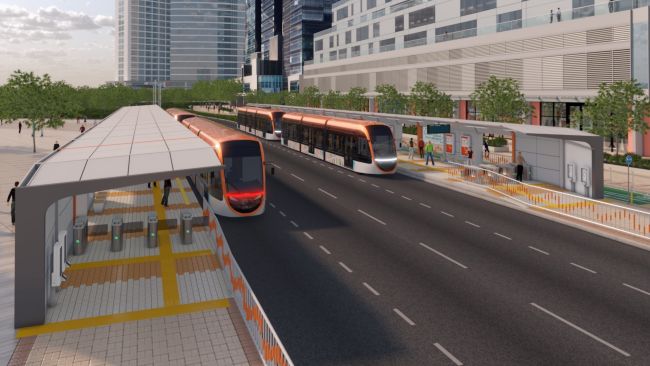
Leveraging advances in smart transit technology, the new system will utilize lightweight, electrically powered vehicles capable of negotiating steep gradients without the need for overhead power lines. The flexible alignment is designed to overcome the area's complex topography while providing a sustainable and efficient transport solution.
Public-Private Partnership Model
Similar to the Kai Tak Smart and Green Mass Transit System, the East Kowloon project will adopt a concession model under which a private operator will be responsible for financing, design, construction, operation and maintenance.
To enhance commercial viability, the Government will provide financial support through the grant of development rights for three residential sites to the successful concessionaire. These include:
- The Ma Yau Tong depot site;
- A Kai Tak site comprising Sites 1 and 2 in Area 3E;
- The Cha Kwo Ling Road site adjacent to Kwun Tong Road.
Under the tender arrangement, bidders will be required to propose a fixed payment to the Government as a key financial assessment criterion. The selected operator will receive the development rights to the three sites through private treaty grants at a nominal land premium while making the committed payment to the Government.
Major Benefits for Communities
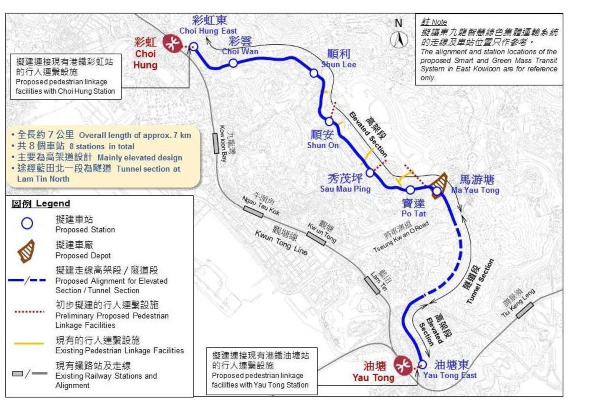
Upon completion, travel time between Po Tat Estate/Sau Mau Ping and Yau Tong or Choi Hung is expected to be reduced to approximately 10 to 15 minutes, representing around a 50% saving compared with existing road-based journeys.
The system will serve more than 300,000 residents and provide access to over 40 public and private housing estates. It will also improve connectivity to more than 50 major healthcare and community facilities, as well as over 35 schools.
The Government noted that extensive public engagement was undertaken during the planning stage, including more than 20 consultation sessions and site visits. The scheme will incorporate 24-hour pedestrian links, together with dozens of escalators and lifts to strengthen accessibility across the district's steep terrain.
Particular attention will be given to improving barrier-free access for elderly and mobility-impaired residents, including enhanced connectivity between Shun On Station and the Christian United Hospital.
Boost for East Kowloon Development
Industry observers view the approved financing model as an innovative approach to delivering large-scale transport infrastructure while integrating transit-oriented development opportunities. The combination of transit investment and residential development is expected to stimulate urban renewal, increase land values and support long-term growth in East Kowloon.
With tendering scheduled to begin next month, the project is expected to attract strong interest from international transit system suppliers, infrastructure contractors, developers and consortiums seeking participation in one of Hong Kong's most transformative mobility projects. (Reported by Building.hk)