|
|||
| HONG KONG | <Search <Archives <eBulletin Next> | ||

February 23, 2026 Hong Kong International Airport T2 Departure Facilities: From Vision to Opening The original Terminal 2, opened in 2007, functioned primarily as a landside check-in facility with passengers shuttled to airside departure halls via the Automated People Mover (APM). With traffic recovery ramping up and airlines seeking more direct processing at T2 itself, the expansion aimed to transform T2 into a full-service passenger terminal — capable of supporting departures, arrivals and transfers with modern amenities and advanced technologies. Early Planning and Integration (Pre-2016–2019)
The T2 expansion was embedded within the broader 3RS Master Plan, initiated under Hong Kong International Airport Master Plan 2030. Detailed planning, stakeholder consultations and environmental assessments laid the groundwork for the wider airport transformation.
Construction Phase (2019–2025)
Terminal 2 was closed in late 2019 to facilitate construction and integration with the expanded airport layout. Building works included enlargement of the main terminal building, introduction of new check-in halls, expanded security and immigration processing areas, and connections to landside transport.
A key early milestone was the opening of the new Coach Hall on 23 September 2025, which consolidated cross-boundary coach and limousine services under one roof and offered 41 parking bays for arrivals and departures. This facility began operations ahead of the main terminal opening to relieve traffic pressure at Terminal 1.
Departure Facilities Commissioning (2026)
On 17 February 2026, AAHK announced that the new passenger departure facilities at T2 will commence operations on 27 May 2026 — timed to coincide with the summer peak travel season.
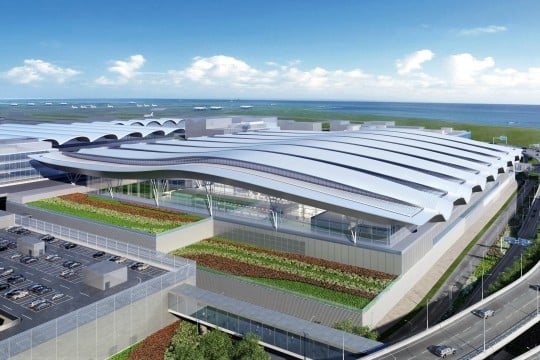 (AAHK)
Terminal Features and Passenger Experience
When operational, the expanded Terminal 2 will offer:
Seamless landside integration — connected directly to the Airport Express platform and Terminal 1 through climate-controlled footbridges.
Smart departure processing — state-of-the-art biometric check-in and security lanes with next-generation automation aimed at reducing minimum connection times.
Enhanced passenger capacity — the expanded T2 forms part of the overall 3RS capacity uplift, supporting substantial increases in annual handling volumes (in the order of tens of millions of passengers).
Improved connectivity — the Automated People Mover (APM) and new Baggage Handling System (BHS) will link T2 efficiently with the planned new concourses and gates, facilitating smoother passenger and baggage flow.
Modern public spaces — passenger flow prioritised through larger, technology-enabled halls and transit connections designed for future adaptability.
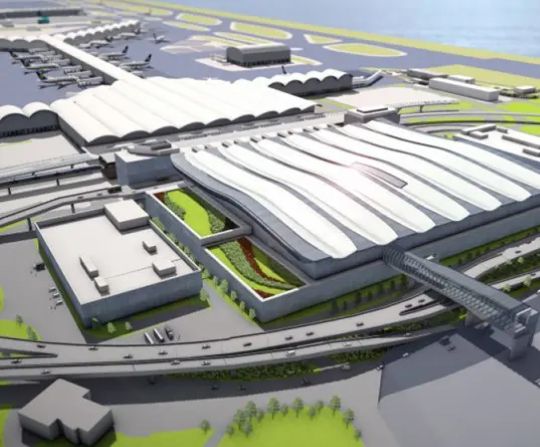 The expanded Terminal 2 main building (excluding regulatory annexes and concourse) now houses multiple vertical levels — reportedly up to eight storeys — and provides modern passenger check-in, security, immigration, baggage systems and public areas.
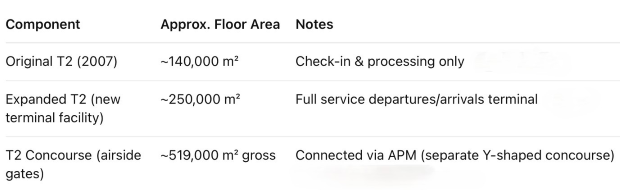 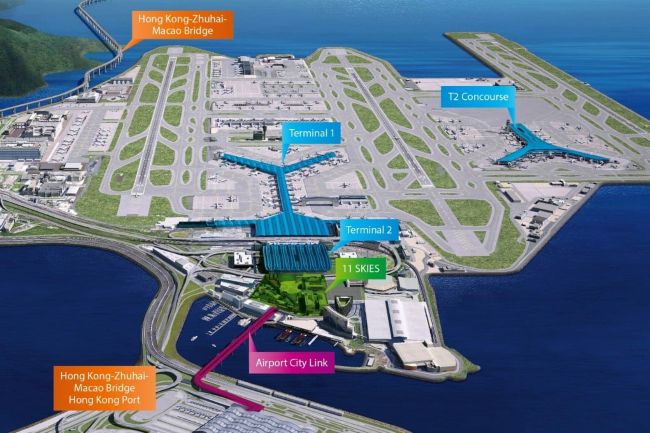 (AAHK)
Project Lead Consultant & Architect AECOM
Structural & Façade Consultant
TTW Engineers
Main Contractor (Superstructure)
Gammon Engineering & Construction
Main Contractor (Foundation & Substructure)
Leighton-Chun Wo Joint Venture
(Reported by Building.hk)
|
|



|