|
|||
| HONG KONG | <Search <Archives <eBulletin Next> | ||

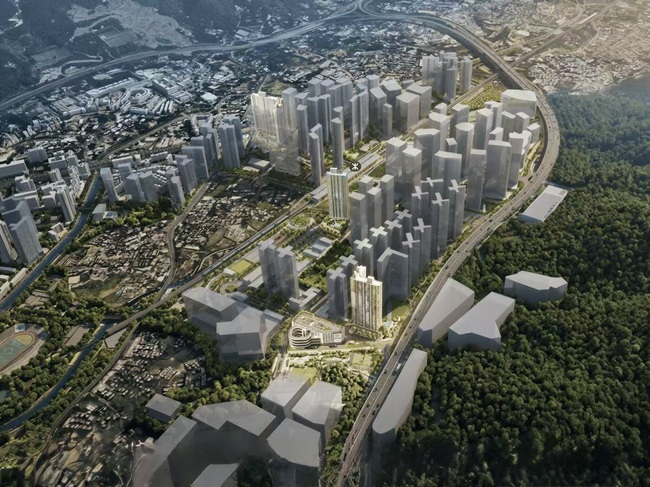
September 8, 2026 HSK Logistics Cluster: Government Invites EOI for Five Strategic Sites The Transport & Logistics Bureau, in collaboration with the Civil Engineering & Development Department, recently invited market expressions of interest (EOI) to develop selected land parcels for a modern logistics cluster (HSK Logistics Cluster) in the Hung Shui Kiu/Ha Tsuen New Development Area. The five selected sites, ranging from 3.1 to 5 hectares, were identified following a preliminary market sounding exercise. They comprise three parcels in Zone B, which focuses on e-commerce logistics, one in Zone A, focused on high-value goods logistics, and one in Zone C, which focuses on freight forwarding and the low-altitude economy.
Development will be implemented in phases with Zone B forming the first batch. The three parcels within Zone B will become available by late 2027 or early 2028 at the earliest. If combined, they can cater to larger-scale development. The single land parcels in Zones A and C will be made available at a later stage.
Through this EOI exercise, the Hong Kong SAR Government aims to gauge industry interest in developing the first five available sites within the HSK Logistics Cluster. It is also seeking views on the proposed development terms, infrastructure requirements, development scenarios, land disposal options and financial viability. The feedback collected will help the Government formulate the land lease terms and development mode.
The deadline for EOI submissions is noon on November 13. A briefing session will be held on September 11, with details available on the HSK Logistics Cluster webpage.
 (HKSARG) Commercial Analysis: A Timely Bet on a Rebounding Sector
The EOI comes at an inflection point for Hong Kong's industrial and logistics property market. While the broader commercial real estate cycle remains soft, several structural and cyclical forces are converging to make modern, purpose-built logistics space an increasingly compelling proposition for developers, investors and occupiers alike.
1 Leasing demand set to recover, but rents still under pressure
According to CBRE's 2026 Hong Kong Commercial Real Estate Outlook, industrial and logistics leasing demand is expected to gradually improve in 2026, driven by emerging industries and pre-leasing of high-specification facilities. However, the recovery is unlikely to be rent-accretive in the near term: warehouse rents may drop by about 5% over the year, as new supply continues to weigh on pricing even as take-up edges higher. For the Government, this means the EOI's emphasis on gauging "financial viability" is well-placed — developers will be pricing in a market where rents are still finding a floor, even as demand momentum turns positive.
The zoning strategy for the HSK Cluster aligns closely with the demand pockets CBRE identifies as growth drivers. Zone B's focus on e-commerce logistics taps directly into the structural shift toward online retail fulfilment, while Zone A's high-value goods positioning speaks to the premium-specification segment where tenants are actively upgrading — a trend CBRE notes is supporting rental growth potential in high-standard logistics parks even amid broader softness.
2 Capital markets warming, with logistics a top investor pick
On the investment side, the backdrop is more encouraging. CBRE's 2026 Asia Pacific Investor Intentions Survey finds that Hong Kong has returned to the top five cross-border real estate investment destinations, with over 57% of respondents indicating they hope to buy more real estate in 2026. Investors are shifting from defensive strategies toward growth-oriented positioning, and industrial and logistics ranks among the top three target sectors across Asia Pacific. REITs, institutional investors and large funds are expected to be more active buyers this year.
For the HSK Cluster, this is significant. The phased release — with Zone B parcels available by late 2027 or early 2028 — coincides with a window in which institutional capital is actively seeking logistics exposure. CBRE projects that further rate cuts will drive investment demand, with overall Hong Kong investment volume expected to grow moderately by about 5% in 2026. The option to combine Zone B parcels into a larger-scale development will be particularly attractive to institutional buyers and REITs seeking assets of meaningful scale.
3 Smart logistics and the low-altitude economy as differentiators
Zone C's dual focus on freight forwarding and the low-altitude economy places the HSK Cluster at the forefront of two emerging demand streams. Regional logistics trends point to accelerating adoption of smart warehousing and automation — including unmanned forklifts and automated sortation systems — as operators pursue efficiency gains. High-specification logistics parks that can accommodate these technologies are precisely the assets seeing rental growth potential, as tenants upgrade from conventional space to premium, tech-enabled facilities.
The low-altitude economy focus is especially forward-looking. By reserving land for uses tied to drone logistics and low-altitude operations, the Government is positioning the cluster to capture demand that does not yet exist at scale but is widely anticipated across the Greater Bay Area. This gives Zone C a distinct value proposition relative to conventional logistics stock, though it also carries the highest development-timing risk — which likely explains why it is scheduled for a later release alongside Zone A.
4 What to watch
Several factors will shape the commercial case for the HSK sites. CBRE flags rising labour and construction costs, geopolitical tensions and interest-rate risk as the principal challenges facing investors in 2026 — all of which feed directly into the development cost assumptions and financial viability assessments the EOI is seeking to elicit. The Government's willingness to listen to industry views on land disposal options and development scenarios suggests flexibility on tenure structure, which could help bridge the gap between current rental levels and the cost of delivering modern, high-specification space.
The September 11 briefing session will be a key moment for prospective bidders to test the Government's thinking on these points. With the November 13 submission deadline still over three months away, there is ample runway for developers, funds and operators to assemble consortia and formulate responses — a process that, if the CBRE investor sentiment data is any guide, is likely to draw no shortage of interest. (Reported by Building.hk)
 |
|



|